










Poland is booming. Or isn’t it? Beyond the headlines, we find sleepy towns, socialist relics, forgotten industrial landscapes, and a country caught between old habits and new ambitions.
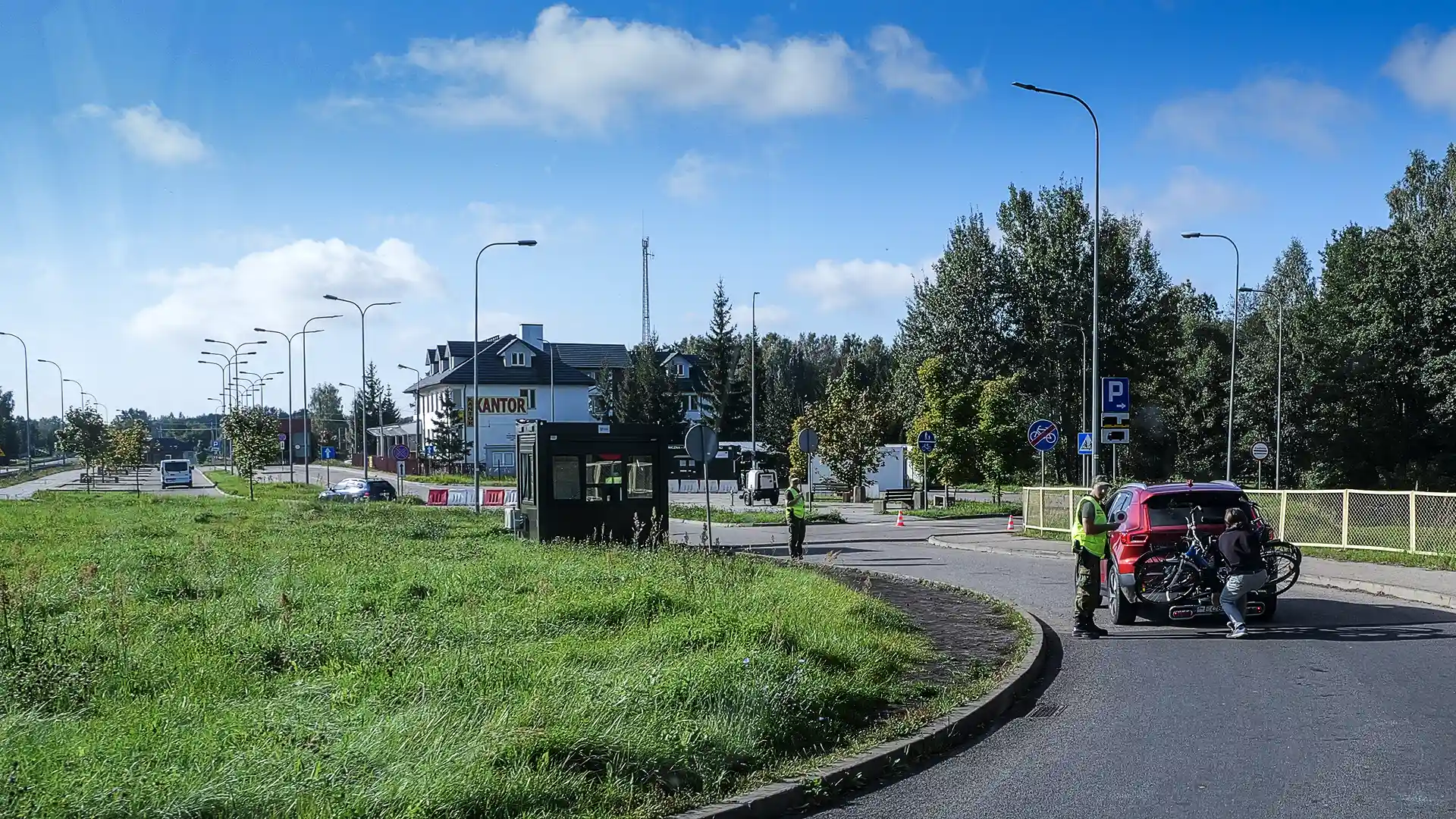
We’re approaching the border. As normal within the EU, there are no border buildings. Astonishingly, 2 guys from border control stop us. After a long explanation in Polish, we ask if someone speaks English. The smart lady does, at least a few words. She asks for ID, license, and car papers. Everything gets carefully checked, and our beautiful faces compared to the ugly pictures on the documents. Ok, we may drive on – but just a few 100m. Then the police stops us. Same procedure, they even check all the documents in their computer. Then we have to open every door in the camper. Obviously, they’re not interested in what we carry with us, just in whether we hide a person somewhere between the 2 cans of beer. Finally, we’re off – welcome to Poland and its surprises.
Shortly later we’re astonished again. We enter the large parking area, and it’s almost occupied. We couldn’t imagine that so many tourists visit the Wigry Monastery. Well, Poland is not the Baltics and surely, it’s more touristy.
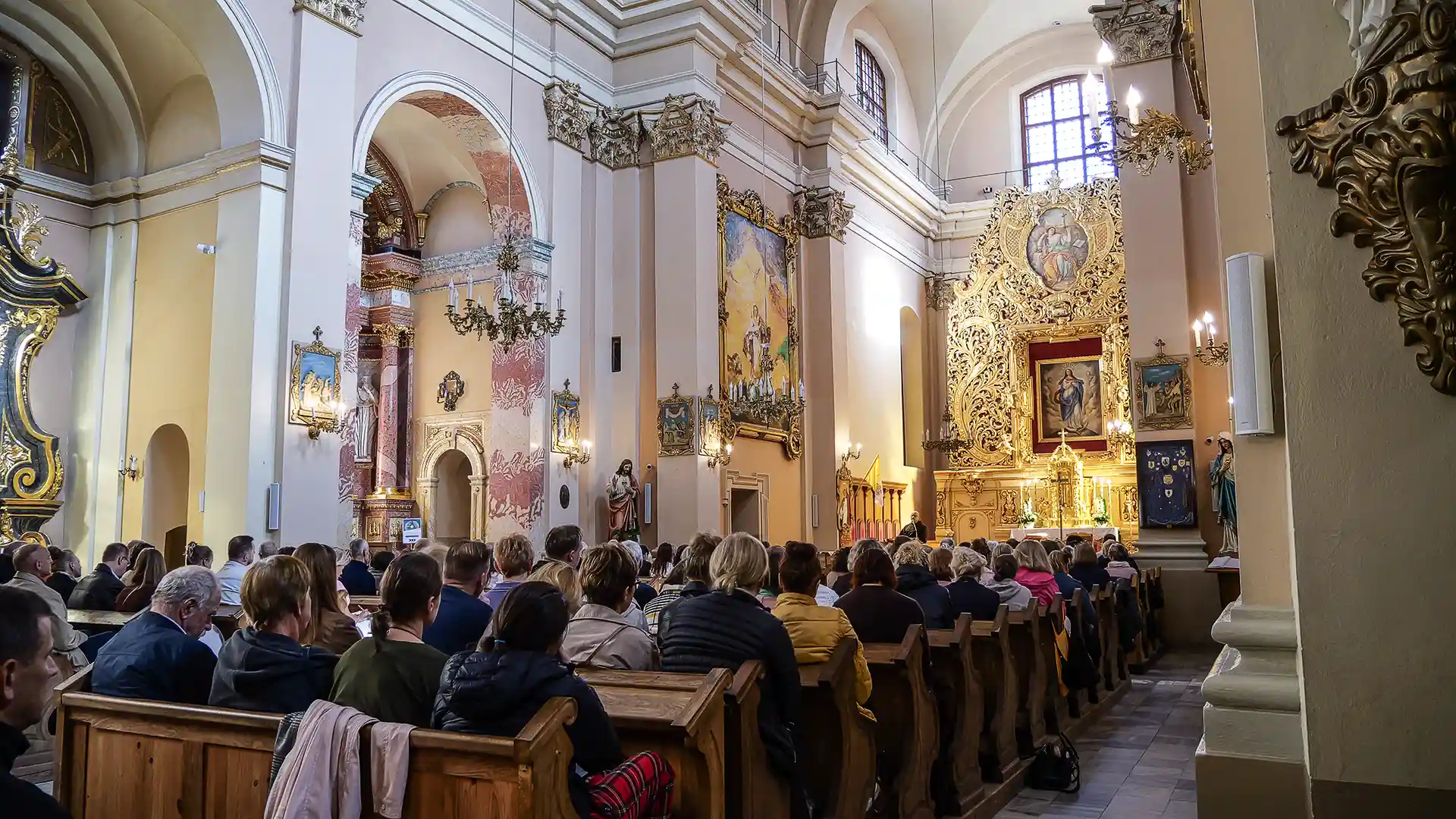
We enter the courtyard, head to the clock tower. Climbing up, we’re amid a tour group. But just a few persons – they’re not the explanation for the many parked cars. Then we see the constant stream of people shuffling to the church. Well, we’ve got to see what’s going on there. Anyway, it’s said to be a church so opulent that it competes with all the Baroque churches in Mexico.
Entering there, it’s packed – the benches, people on the sidewalks, many coming, others leaving, and a priest having a mass. Only now, we realize it’s a Sunday. And visibly, that’s in Poland’s east not the same as in other countries.
We could not really see if the church’s reputation is justified. It was too full and we didn’t know if we could simply visit the church during a mass. Whatever, quite a new experience for us.
We drive on thru the rural landscape, to Bialystock. On the way, again full parking lots. Now at restaurants – it’s noon. We start to imagine how it works: Church, lunch in an eatery, probably with a few glasses of the best vodka – and that’s the perfect Polish Sunday.
Later, in Bialystock, we sneak thru its old town – just a few roads lined with Baroque buildings. A choir singing in front of the museum. The church, of course, just shortly before a mass begins.
In the back roads, these well-known apartment blocks. Just they are in much better shape than those seen in the Baltics.
And finally, one of Poland’s most famous mural – at least according to some sources: the Girl With the Watering Can.
It’s afternoon, golden light, the houses glowing in the low evening sun – Indian Summer at Zamkowy Square.
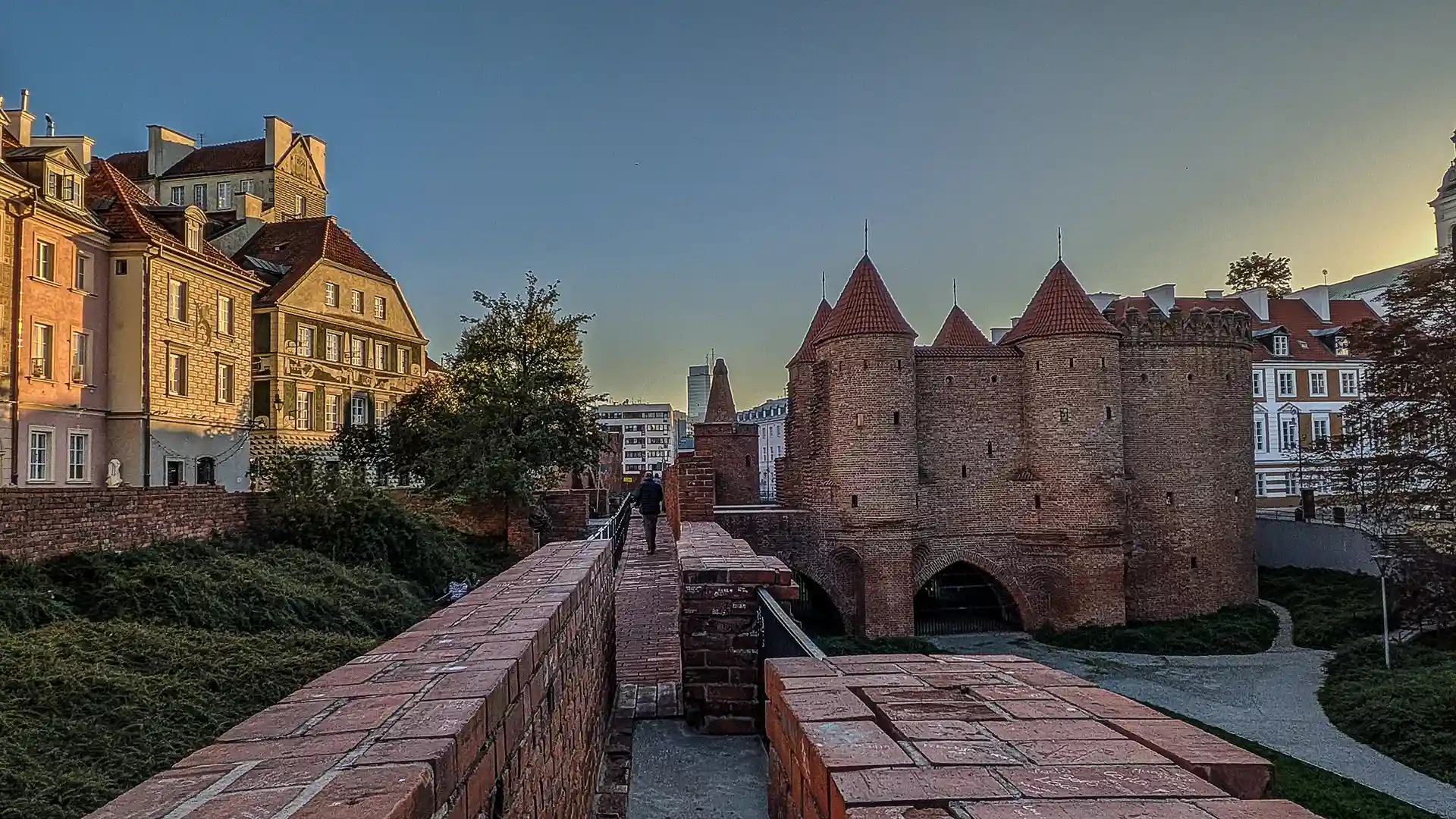
We’re on our way to the old town, trying to imagine what it feels like to visit a historic center that was razed to the ground and rebuilt years later, largely from old photos and people’s memories.
It’s true: no other city in Europe was so completely destroyed as Warsaw during WW II.
We stroll thru the narrow alleys, try our best not to bump into the many other tourists, and ignore every attempt to lure us into one of those terrible tourist eateries.
And after a while, we’ve almost forgotten that these historic houses were only reconstructed in the 50s and 60s.
Look closely, though, and we can spot the cracks in the illusion. Some of the ornamental details were simplified during reconstruction. Others simply weren’t remembered.
And then there are 40 years of Soviet brotherhood – and other priorities than maintenance.
The result? Warsaw’s old town is already starting to look old again.
We leave Warsaw’s old town. Just next to it was the Jewish ghetto, established in 1940 during the Nazi occupation and razed to the ground after the uprising in 1943. Nothing remains except a few street markings, a monument, and a museum. Today, it’s just another neighborhood, built in the ’50s.
Nearby stands the famous Brutalist memorial to the 1944 uprising of the Polish resistance.
OK, that’s historic Warsaw.
In recent years, since the nationalist, right-wing government was voted out, Poland has increasingly been portrayed as one of Europe’s booming economies. During our trip thru the countryside, we certainly didn’t get much of that feeling. Maybe Warsaw is where we can finally see the results.
So, we sneak along Uliza Walicow – a strange mix of decaying old factory halls, socialist architecture, and some of Warsaw’s poshest skyscrapers.
Another Warsaw. And not quite the one we expected.
That’s Poland the way it currently promotes itself.
And just next to all these posh monuments of concrete and glass, there’s another one. The one Uncle Stalin donated to communist Poland.
The Palace of Culture and Science.
A piece of excellence in the dictator’s unique wedding cake architecture.
Inside, it’s pretty posh, but decidedly old-school. Even the elevators bringing us up to the 30th floor – just for the view – seem to have survived from another era.
But there’s another jewel to discover in this building: the Neon Museum.
Neon signs from the communist era – some of the few things bringing color to the otherwise grey cities of the time.
An exhibition you have to see to believe.
The tram crosses the bridge over River Vistula. We’re on our way to Praga.
In the 90s, it was a rundown neighborhood, plagued by social conflicts and gang crime. Today, it’s turning into a hotspot for urban life – a mix of old buildings that survived WW II, communist architecture, and former factories transformed into galleries, watering holes, and offices.
Of course, there are still plenty of spooky corners: decaying buildings, dark alleys, and street art spreading across the walls.
A world apart from the rebuilt Old Town and the posh skyscrapers on the other side of the river.
After the urban chaos of Warsaw, we’re back to a very different Poland: smaller towns with picturesque, and carefully polished historic centers.
We walk along the embankment of River Vistula. From our campsite, it’s just 10 minutes to the Rynek, the main square with its town hall. We turn onto the main street, lined with posh houses built by grain traders in the 16th century – the town’s golden age.
Today, they mainly serve as eateries: quick and lousy lunches for endless busloads of tourists, and something better for hungry individuals in the evening.
The Rynek itself is pretty picturesque, with carefully restored buildings, cobblestone streets, and everything a visitor could possibly need, or not.
A short stroll takes us to a nearby church. True, it looks interesting, with its wooden ornaments.
Then on to the ultimate viewpoint: the hill of the 3 crosses.
This is where we queue up for a while to get our ultimate picture.
Well, that’s Kazimierz Dolny.
A well-known destination for tour groups and a weekend retreat for people from Warsaw. Pretty nice, but small enough to see it all in an afternoon. Tomorrow, another Polish old town awaits.
It’s a pretty short drive thru Poland’s farmland to reach Lublin. The city is said to have the most beautiful and splendid historic center in the country. One of the few old towns that largely survived WW II intact.
After all the old towns we’ve seen so far, let’s see.
We cross the huge Lithuanian Square with its fountains and sneak along the avenue toward the gate to the historic center …
… – and enter another world. Tidy, nicely restored buildings, cobblestone alleys lined with eateries, watering holes, and souvenir shops. And quite a few tourists hanging around, taking selfies or listening to their guides.
Of course, there’s a Rynek with everything it needs, narrow side alleys where the beautification program hasn’t arrived yet, and a church that’s maybe a bit overloaded with golden statues.
Finally, we head to the castle. The building itself is really not a beauty – it rather looks like the result of a failed restoration.
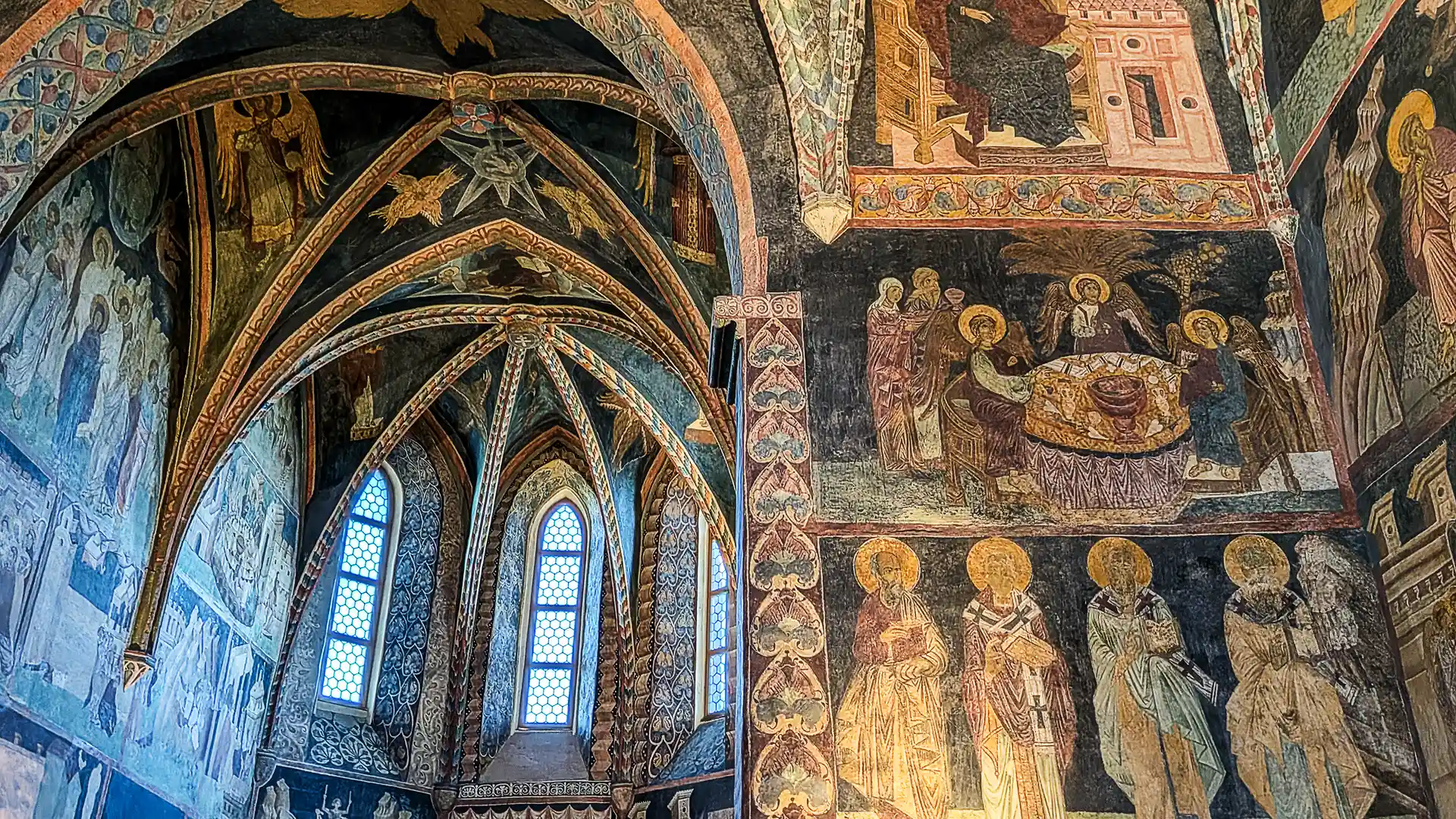
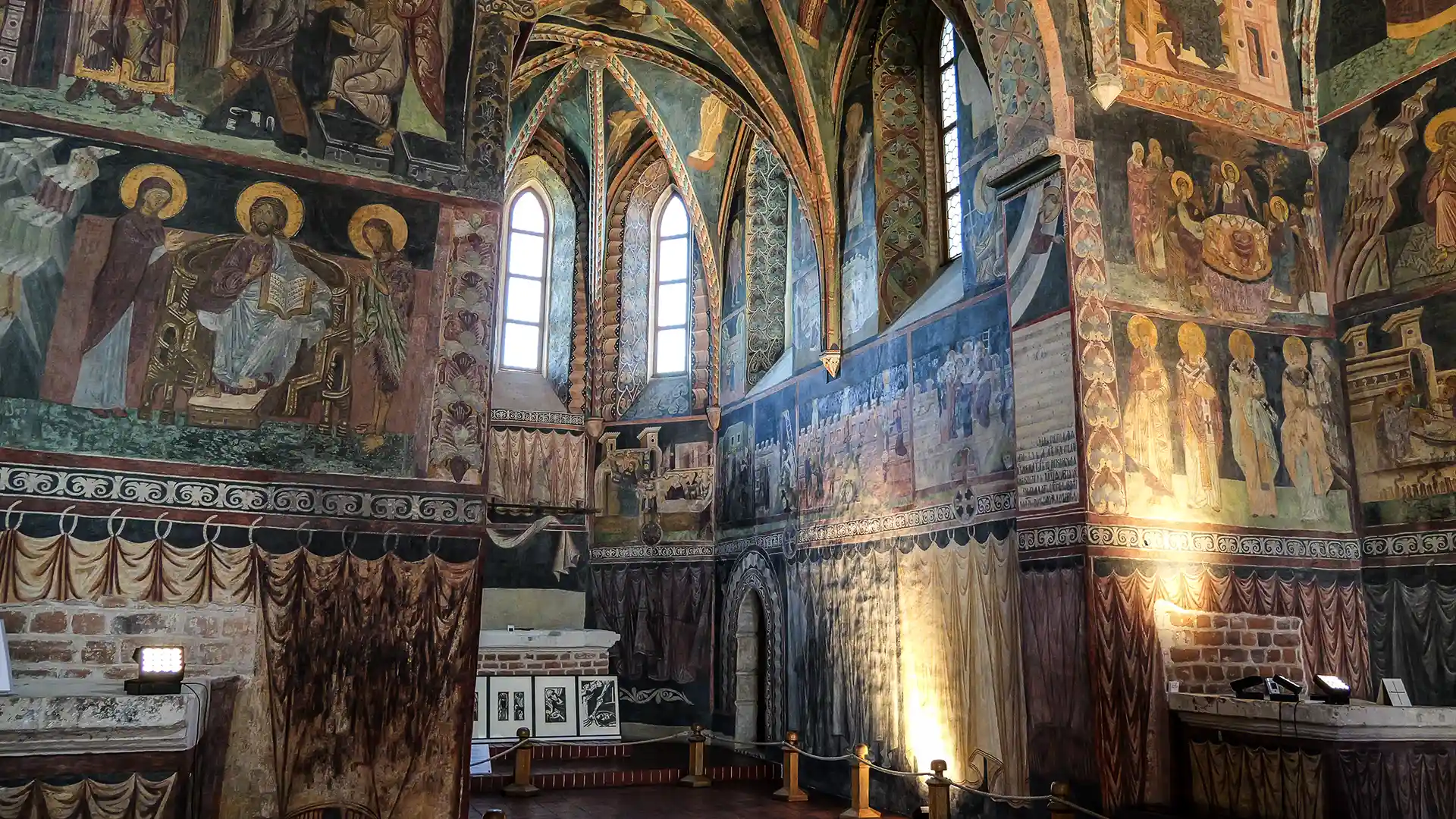
But inside is something completely different: a world-famous chapel covered in Byzantine paintings.
And that’s the place to go. Spectacular.
Well, that’s Lublin.
Another destination famous for its old town. It all looks nice and photogenic, with some picturesque corners, but again, it’s quite similar to the old towns we’ve seen in Poland so far.
Whatever. Tomorrow, we’ll give another Polish town a chance.
Definitely, the main road isn’t a beauty. Many houses look run-down, …
… most shops are seriously old-fashioned, and even the people on the street seem to ignore the fact that fashion has changed in the last 30 years.
We’re really wondering where the hell we are. No sign of a flourishing, booming Poland – it all looks pretty conservative and stuck in the past.
Well, that’s Tarnów, a small industrial town not far from famous Krakow.
Finally, we enter the small old town. As everywhere in Poland, the picture changes: carefully renovated houses, eateries, and hardly any tourists.
We sneak along the Rynek, explore a few side alleys, and finally reach the memorial to the Jewish community — a small section of the synagogue that survived after the Nazis burned it down in 1939.
We continue thru the narrow alleys. Then suddenly, something strange catches our eye. Russian signs. Everywhere.
We can’t imagine why. We find them on doors in different streets. Something we have to figure out.
We know Putin is trying hard to influence Polish society, but we’ve never heard that it had reached this far.
Then we arrive at a square packed with trucks. Their signs indicate they’re involved in the film industry. OK. Something is going on.
Only in the evening, after consulting Google, do we discover the truth: a Netflix production is currently being filmed in Tarnów.
So, if you ever watch the remake of the movie Days and Nights, you’ll know: that’s Tarnów.
What a relief.
It wasn’t Putin after all.
Dear readers,
That’s it for this post. On our way back from the Baltics thru Poland, we wanted to find out where Poland stands today: stuck in the lethargy of conservatism, or surging ahead as a liberal society and one of Europe’s booming economies, as the press often portrays it?
Well, we’re still not sure. But maybe Poland isn’t that different from anywhere else. The countryside stays much as it has always been, while the cities boom. And the gap keeps widening.
Cheeeers, see you soon.
Monika’n’Martin