
Armenia – 10 000 Monasteries – and Nagorno Karabakh – a Non-Existent State
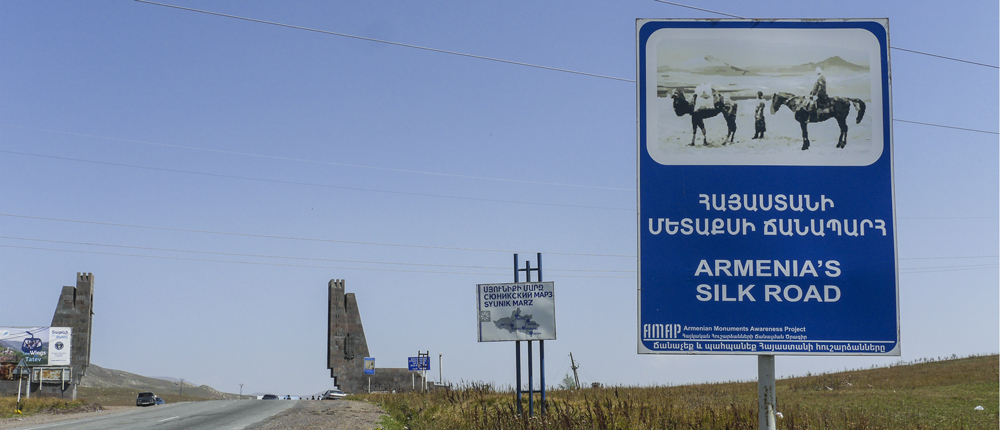
After more than 3 weeks in beautiful Georgia, time for a change: Armenia’s Silkroad and its monasteries and a state not recognized by anybody – Nagorno Karabakh.We leave Tbilisi on the southern highway in direction of the Armenian border.
There, at the Georgian border a matter of minutes, as well as at the Armenian one. Even visa are waived for Schengen countries.
But then – after Armenian immigration’n’customs – suddenly we realized that we need a TIP for Prado. We queue up to convince the ATM to give us some of this strange local currency called Dram to pay at the bank. Then we queue up to have a form filled in by a broker. Finally, we queue up to have the form stamped by a customs officer – and 20’ later we were back on the road. Somehow strange – we got a 120 days permission to stay in Armenia. Prado 15 days only.
This means we somehow have to rush thru the country or return in the middle of our Armenian trip to Georgia get o another 15 days asylum for Prado. But 1st we drive in the direction of Alaverdi in the Debed Canon.
10th September, Alaverdi

All looks a little more rundown than Georgia, houses seem to have very few time left before they will completely collapse, numerous unused and rusting industrial complexes just wait to be demolished and roads definitely are narrower and more potholed.
Nevertheless, everywhere we can discover the former pride of the Soviet bus industry still running in a reliable manner to every village in the country. By now equipped with ordinary gas bottles on the roof to substitute diesel.
We arrive in Alaverdi, the biggest town in Debed Canon.
Pass old Soviet built copper mines. Images of a rather postindustrial age, but without having developed alternatives to the mining business.
In Alaverdi, of course we have to stay at Iris’ GH. Simply because all are doing so and it’s defnitiely the place with the nicest hosts.

A tour to the CBD and a curious look at the shelves of a supermarket.


Then a visit to the famous monasteries in the canon, some UNESCO World Heritage Sites.
First of all to Sanahin – 1 of the most atmospheric in whole Armenia.

Then Akhtala, the only 1 with frescos in Armenia…


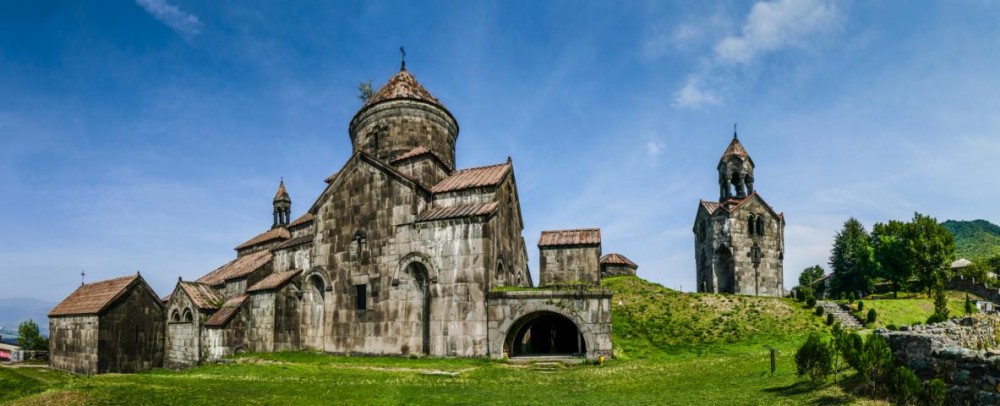
… and finally Haghpat – the other World Heritage.

11th September, Dilijan
On the way out of the Debed Canon, near the village of Dsegh the remote Surp Grigor Bardzrakash Monastry. Overgrown and in a state of disrepair. But still in use.

On to Dilijan in the so-called Armenian Swizzyland. We stayed at Villa Dilli GH – a so la-la accommodation, but with great food.
In town a look at its most important monument. The well-beloved concrete construction to remember 50 years of the highly appreciated Soviet colonisation of Armenia. Nowadays a structure showing slight signs of negligence and without any other visitor in sight.

In the surroundings of Dilijan some more opportunities to visit monasteries.
Goshavank …

… and Haghartsin. This 1 interestingly renovated with financial support of the ruler of Sharjah.

12th September, Yeghednadzor

On to Lake Sevan. A look at the Sevanak monastery on the peninsula. A real tourist hotspot.

For a little money you can even significantly contribute to world peace by releasing peace doves. And thus enter the glory book of heroes.

Further on along Lake Sevan. On the way a look at the Hayravank Monastery and the khachkar-studed cemetery in Noratus (wiki it at https://en.wikipedia.org/wiki/Khachkar).


In Noratus we meet the nice lady on the right side. She’s selling Mongolian wedding socks to the over optimistic tourists who still think they might some when marry a Mongolian beauty on their trip on the Silk Road.
Enough cultural stuff, on to Selim Pass at 2400m. Great lonely landscape, quite cool and …

… on the other side the historic caravanserai. Here again, our doubts if really camels were the means of transport on the Silk Road. The relief rather indicate odd cows.

The night we spent at the newly opened camping in Yeghednadzor.


In the evening to the Norvank monastery – probably the most scenic one in all Armenia.


13th September, Goris
A little over 100 km to Goris. Over high passes, where even poor Prado had problems to climb due to the “wonderful” local diesel…

… in Sisian a look at Zorat’s Karer – rather mysterious tombs dated 7500 BC (wiki here).

Finally we arrive in Goris. A rather quiet small town with a quite interesting center – strongly reminding us to some pics from Soviet times – a faded grandeur.

15th September, Stepanakert
Enough Armenian churches. We move on to another country – even if it’s a state not recognized by any other nation. Thus, somehow we drive to a non-existing place: Nagorno Karabakh. This piece of land which separated from Azerbaijan in the 90ties after many years of fiercely fights between whoever thought to be involved into global strategies and politics reduced to a few km2 in the Southern Caucasus

In Goris for Prado a last few liters of bad quality diesel and we’re on the road.
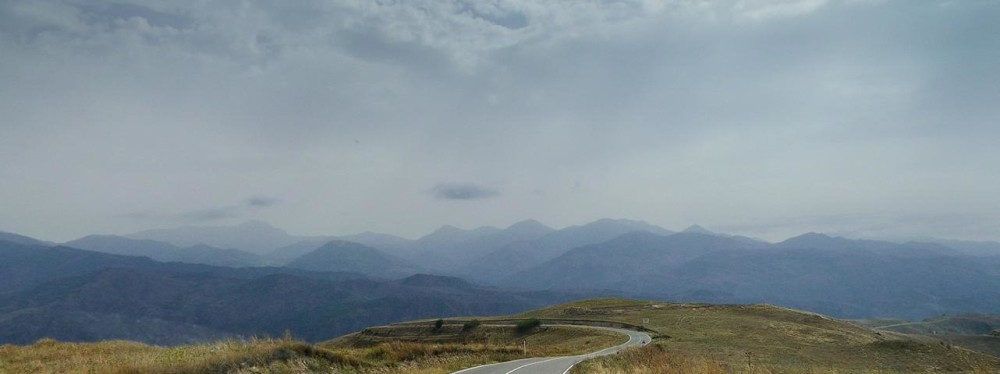
Over the mountains a few km to the border. No checkpoint at the Armenian side. The officials of the Republic of Nagorno Karabakh made photocopies of the passport and we had to swear that we’ll pass at Foreign Affairs in Stepanakert, the capital, to get all kind of paper stuff. And that’s it.
The 1st place on the way Shushi. High up in the mountains, during the war it was a stronghold of Azeri and Soviet troops to fight the Karabakhies. Thus, even 20 years after the hostilities came to an end, many parts of the town still look like having suffered fierce urban warfare just last week.


A visit to the 2 mosques. Both heavily damaged during the war and vandalized afterwards. Currently being restored by some Iranian guys.


We move on to Stepanakert. On the way a short stop at 1 of the places to commemorate Karabakhi heroism.
And then the view of the all impressive skyline of Stepanakert. The proud capital of the Republic. Home of some 50 000 rather lost souls.

A visit to the National monument they call We Are The Mountains. Nevertheless rather looking like a brave’n’heroic couple – maybe Kara and Bakhi.
Stepanakert’s CBD looks very neat, no visible marks of the war. Everything very clean and supposedly well organized.

Our 1st act is a visit to the Ministry of Foreign Affairs to get the visa and the registration within 10’. An efficient but rather small Ministry. Quite understandable, considering the fact that a non-recognized state has probably not too many international commitments.

A visit to the center of power …


… and finally a much deserved beer.
There are not many places you can really visit in Nagorno Karabakh. This is mainly due to its size. But also because you better don’t approach the border to Azerbaidjan because of continuing fighting and the hell a lot of mines. Nevertheless, we decide to cross the country to the north to visit 2 more churches. Some of the signs at the roadside were quite encouraging that everything is fine.

1st to the monastery of Gandzasoar, about 1h north of Stepanakert, …


… then to the remote one in Dadivank, near the northern border to Azerbaijan. On the road more evidence of the fierce battle between the Karabakhies and the Azerbaijanis.


Back to Stepanakert, we have to experience something new: the Restoran Russia. A rather unusual place for the proud capital of the Republic of Nagorno Karabakh – but with a huge selection of good food.

16th September, Goris

The next day to Stepanakert’s great war memorial. Of course all historic battles are represented. Nevertheless, the 1989-94 independence is an absolute priority with a cemetery surrounding the whole memorial. Each graveyard with the pic of the guy killed in action, often together with his weapon to fight his enemy.
Then back to Goris. Immigration takes 1’ – just to return the registration form. And we’re back in an existing state.

A visit to Tatev. Probably the most touristic monastery outside Yerevan area.


19th September, Yerevan

About 250km to Yerevan. Again crossing several mountain passes elevation up to 2400m.
Climbing up the 1st pass again Prado shows clear signs of chronic exhaustion. A look at the engine – nothing conspicuous. Pumping the diesel filter helps for the moment.
So we continue enjoying the awesome landscape.

A few hours later, without further problems we approach the outskirts of Yerevan, the great capital of Armenia. We discover a trustworthy car repair shop. Take a spare diesel filter and explain the guys in our best Russian that it should be changed. Half an hour later and being 6 Euros worse off we’re back on the road on the way to the city center.
Even if a rather big city, Yerevan’s CBD is quite small with lots of heroic monuments, …


… more or less fashion conscious, selfie amorous people and many street side cafes – mainly selling alcoholic drinks …
… representative buildings and streets, …

… and of course great opportunities to replace your rather shabby T-shirt with a new one.

A visit to the genocide monument and museum.


Finally, outside Yerevan our hopefully last visit to a monastery in Geghard …

… and the Greek temple of Garni. A place you definitely don’t feel alone with all kind of entertainment for the odd tourist.

Back to Yerevan. A last important sight not to be missed: the Cascade, a monument dedicated to the eternal friendship resulting from Soviet Colonialism in Armenia celebrating its 50th birthday many years ago.
For that all important event a huge monument had to be constructed. Unfortunately, the time to construct it was longer than the eternal friendship lasted. The Soviet Empire collapsed – and with it the remaining construction of the monument.


Nowadays, a rich guy promised to correct history. Thus, to finish the monument and to use it as an art center or maybe to definitely finish Soviet – Armenian friendship. Whatever, who knows. Rumors say the guy may be the gentlemen at the right. Who knows.
Anyway the view on the top of the monument is spectacular.

So far our slightly congested Armenian trip.
Thanks for the patience following us to all these monasteries. Believe, we also needed some patience.
Cheeeers, c u soon
Monika’n’Martin